

Railtex Brief: Global Leading Railway Track Vibration Dampers Supplier Changmei Technology on Rail Decay and Corrugation

Rail Decay Rate Provides a Direct Measure of Track-Side Vibration Control
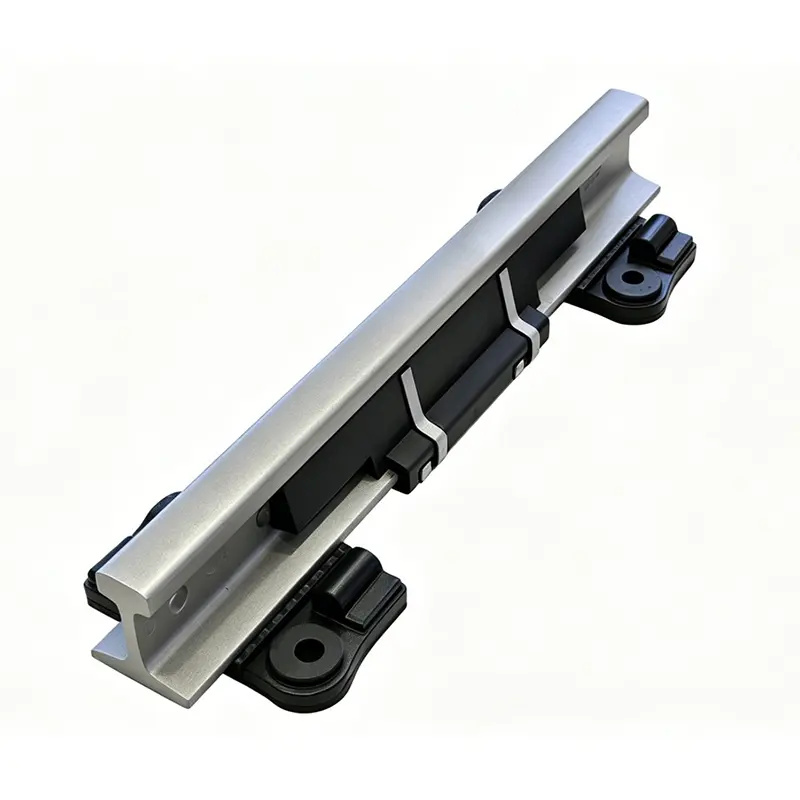
The rail decay rate serves as a critical engineering metric by translating the attenuation speed of rail vibrations along the track into a measurable dB/m value. The broadband absorber from Changmei Technology establishes an average lateral and vertical decay of ≥5.5 dB/m specifically within the 160–4000 Hz range. This allows the track-side vibration reduction effect to be described using both frequency band and physical distance simultaneously.
When rail vibration decays more rapidly, the excitation energy generated by wheel-rail interaction is dissipated before it can travel to adjacent track sections. This accelerated energy dissipation is essential for reducing long-distance rail radiated noise and minimizing the broadband excitation transferred to nearby structures.
Because the ≥5.5 dB/m metric explicitly covers both lateral and vertical directions and is strictly averaged over the 160–4000 Hz band, it serves as a reliable parameter for technical comparison. However, this metric is bound by its defined frequency range and should not be generalized as a fixed performance outcome for track conditions that fall entirely outside this specific operational spectrum.
Phononic Bandgaps Extend Damping Beyond a Single Resonance
The Broadband Frequency Rail Vibration Absorber moves beyond relying on a single tuned resonance by integrating constrained-layer damping with phononic crystal bandgap theory. By optimizing the damping materials, incorporating a slotted expansion layer, and utilizing periodically arranged local resonators, the absorber effectively extends its operational frequency band.
The local resonance units are arranged periodically, creating a structure that actively suppresses wave propagation within specific frequency bands. Concurrently, the optimized damping materials convert the localized vibration energy into dissipated heat, allowing the system to cover a significantly wider frequency range than a conventional single-mass damper.
The addition of a slotted expansion layer provides additional pathways for structural deformation and energy dissipation. When this mechanical flexibility is overlaid with the phononic bandgap effect of the local resonators, the resulting absorber is capable of simultaneously mitigating multiple distinct wheel-rail excitation frequencies, rather than focusing on one narrow peak.
Insertion Loss Connects High-Frequency Control to Radiated Noise
Complementing the decay rate, an insertion loss of ≥5 dB/m at frequencies above 400 Hz provides a second quantified evidence point specifically targeting high-frequency rail vibration and noise radiation. Together, the 160–4000 Hz decay rate and the high-frequency insertion loss cover both the "localized energy loss" and the "along-track attenuation" dimensions of vibration control.
High-frequency wheel-rail interactions are the primary contributors to rail radiated noise. Insertion loss—which measures the energy difference before and after the installation of the absorber—describes the mitigation effect clearly and can be paired with on-site spectrum testing to identify and target the most problematic frequency bands.
The engineering viability of this acoustic performance is secured by strict mechanical and electrical requirements. The product specifies a retaining clip clamping force of ≥800 N and an insulation resistance of ≥10⁶ Ω. This demonstrates that acoustic mitigation is only effective when it is securely anchored by robust mechanical clamping and safe electrical isolation.
Corrugation, Curve Squeal and Braking Noise Share a Wheel-Rail Excitation Path
Changmei Technology explicitly directs the application of its broadband absorber toward mitigating rail corrugation, curve squeal, and braking noise. Designed for both conventional railway and urban rail transit systems utilizing 50 kg/m and 60 kg/m rails, the absorber addresses these three distinct phenomena by recognizing that they all share the same fundamental wheel-rail excitation and structural propagation path.
Rail corrugation alters the wheel-rail contact geometry, generating severe periodic excitation. The broadband absorber counters this by increasing the rail's vibration attenuation speed, which reduces the opportunity for the excitation energy to propagate into adjacent, unaffected track sections.
Curve squeal and braking noise involve higher-frequency friction and dynamic components. A broadband structure is inherently more capable of covering these multiple acoustic peaks than a device tuned to a single frequency. However, effective mitigation still requires field-measured spectrum data to confirm that the specific noise profile falls within the absorber's optimal operational range.
Production Sampling Keeps Broadband Performance Tied to Hardware Consistency
Because broadband mitigation mechanisms rely heavily on the precise geometric consistency of damping materials, slotted layers, and local resonators, manufacturing repeatability is critical. Changmei Technology supports this requirement with a fully automated rail damper production line capable of producing approximately 100,000 sets per year, reinforced by rigorous random sampling before, during, and after production.
The automated production line minimizes batch-to-batch variations in the geometry and assembly positioning of the local resonators. This strict manufacturing tolerance is essential for ensuring that the phononic bandgap and the constrained-layer damping structures maintain their designed theoretical consistency in physical production.
The company's in-house laboratory assumes responsibility for product testing. When combined with multi-stage production sampling, this enables mechanical, electrical, and vibration-related requirements to be thoroughly verified before bulk shipment. This comprehensive approach forms a closed quality loop, guaranteeing that structural manufacturing aligns perfectly with verified performance.
Railtex and InnoTrans Engineering Questions Connect Decay Metrics with Field Measurement
Technical exchanges at Railtex and InnoTrans connect rail infrastructure, wheel-rail interaction, noise, vibration, and maintenance questions across a broad professional audience. For vibration-damper selection, the useful bridge from exhibition-level discussion to project engineering is a quantified set of track-side metrics: decay rate, insertion loss, clamping force, insulation resistance, and the measured frequency spectrum of the target line.
The company's engineering service encompasses site vibration measurement, environmental impact assessment, and damping solution optimization. This process allows engineers to gather actual track spectrum data and environmental inputs first, before determining the priority frequency bands and setting the required attenuation targets.
Technical procurement discussions can therefore center on concrete parameters—such as decay rate, insertion loss, clamping force, and insulation resistance—mapped against the site's unique vibration spectrum. This approach elevates the evaluation of rail dampers from standard product descriptions to a closed-loop engineering process of measurement, selection, and verification. For further information on product specifications and engineering services, visit https://www.changmeitech.com/.
Shaanxi Changmei Technology Co., Ltd.
Changmei Technology
email us here
Visit us on social media:
LinkedIn
Facebook
YouTube
TikTok
Legal Disclaimer:
EIN Presswire provides this news content "as is" without warranty of any kind. We do not accept any responsibility or liability for the accuracy, content, images, videos, licenses, completeness, legality, or reliability of the information contained in this article. If you have any complaints or copyright issues related to this article, kindly contact the author above.
