

Silicon Photovoltaics Make Power Generation in Space More Cost-Effective
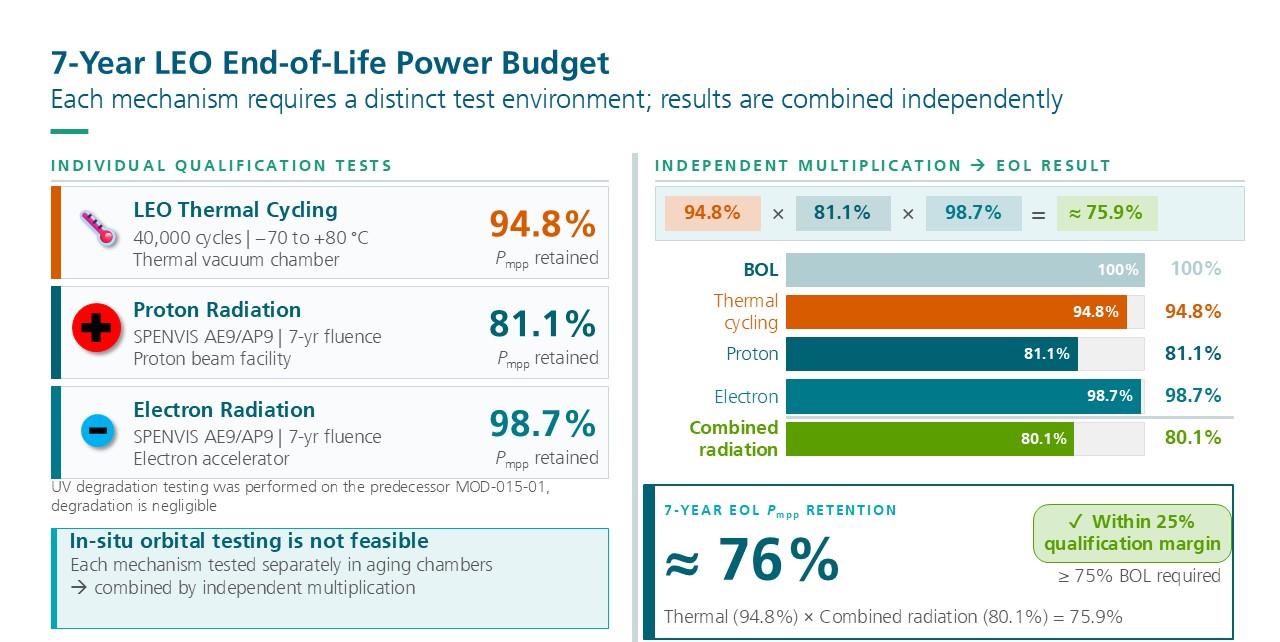
Tests confirm that Source Energy's PV modules and arrays can be expected to deliver 76 percent of their original power output after seven years in space. © Fraunhofer ISE / Graphic: Najwa Abdel Latif
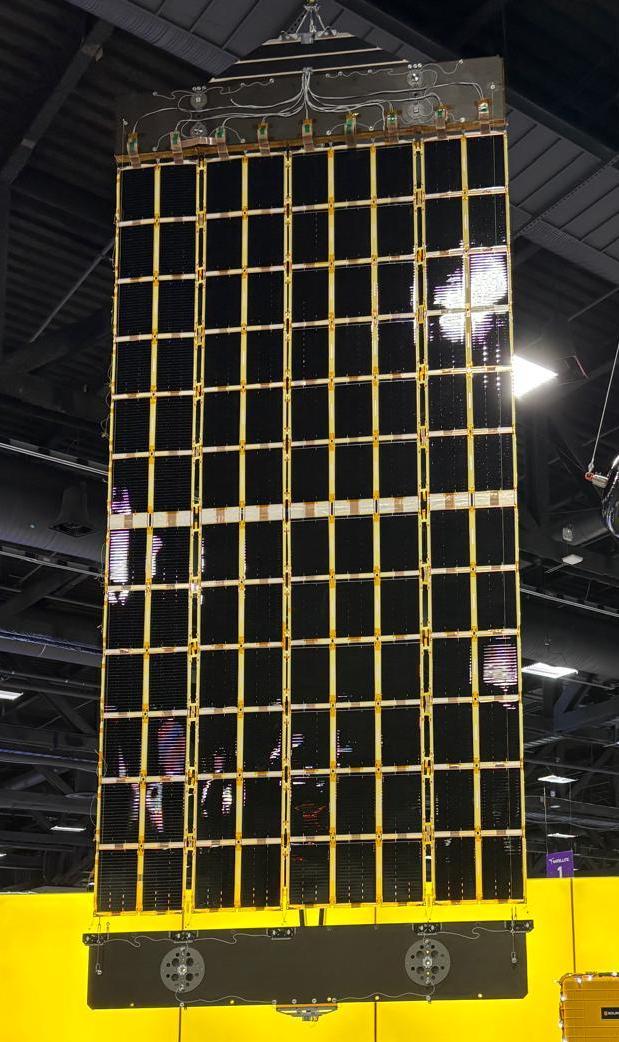
The solar modules use a shingle-matrix interconnection for the solar cells. Combined with silicon solar cells, this makes it possible to manufacture modules at significantly lower cost. Shown: a complete wing with 108 modules. © Source Energy Company
Shingle-Matrix technology from Source Energy and Fraunhofer ISE delivers space-qualified silicon modules that retain 76% of power after seven years in orbit.
Source Energy brought the technology into production in June 2026, installing an industrial shingle-matrix stringer at its manufacturing facility in Colorado. The machine was developed by M10 Solar Equipment GmbH and proven out during a prototyping phase at the Module-TEC facility of Fraunhofer ISE in Freiburg. Under an exclusivity agreement with M10 Solar, Source Energy is the only company in the world with access to the machine for building shingle-matrix solar modules for the space industry. “As the heart of our production, it enables us to manufacture PV panels for less than $5 per watt,” says Bryan Mazor, CTO at Source Energy. “The automated manufacturing process not only makes us more cost-effective but also significantly faster than is currently the case with III-V PV products for space.”
Solar cells based on III-V materials are the current standard for power generation in space. However, their high cost and limited availability are major constraints for commercial missions, particularly Low Earth Orbit (LEO) satellites. “Together with Source Energy, we have therefore developed silicon-based solar modules for space applications, similar to those already in successful and cost-effective use on Earth,” explains Dr. Achim Kraft, head of the PV Module Technologies department at Fraunhofer ISE.
The resulting solar modules are compact and lightweight: 64 grams and 629 square centimeters, (321 by 209 millimeters). The average power output of the prototypes was 15.6 watts – with modules achieving 16.1 watts – and an average active area efficiency of 18.8 percent (AM0 at 25 °C). At 252 watts per kilogram, the module’s specific power is competitive with other silicon modules in its class. The silicon solar cells are interconnected using shingle-matrix technology, where individual solar cells are cut into strips and arranged with certain overlap and spacing relative to one another, like brickwork. An electrically conductive adhesive bonds the solar cells together.
Test results confirm space-readiness
Once on a mission, high resistance to extreme temperature fluctuations is crucial for the solar panels. The research team at Fraunhofer ISE therefore chose product material that can successfully maintain their performance under these conditions. Source Energy subjected the newly developed module to comprehensive space qualification testing and confirmed that it falls within the 25 percent qualification threshold for space applications. Specifically, after seven years of operation in space, the module is expected to retain 76 percent of its original power output.
Shingle-Matrix Design Makes Solar Modules Rugged for Space
“Three features make the shingle-matrix interconnection perfect for space,” explains Najwa Abdel Latif, project manager at Fraunhofer ISE. “Resilience to localized physical damage from impacts by small objects in space, flexibility in layout, and tolerance to extreme temperature differences.”
If the solar panel is damaged – for example, by a small meteorite or space debris – the matrix arrangement of the solar cells allows the current to simply flow around the damaged area. At the same time, the rows and columns of solar cells in the layout can be flexibly adjusted depending on the satellite’s voltage and current requirements.
“The shingle-matrix technology is compatible with wafer-based solar cells featuring front and back contacts, such as PERC or silicon heterojunction, without having to adapt the production line,” says Abdel Latif. “Thanks to the low-temperature interconnection process, there will be no issues with the future technology of perovskite silicon tandem either.”
About Source Energy Company
Source Energy Company manufactures space-grade silicon solar modules and arrays at industrial scale. Founded in October 2021, the company has had hardware on orbit since November 2023 and serves more than 25 customers across telecommunications, defense, Earth observation, in-space services, and on-orbit compute. Source is headquartered in Longmont, Colorado, with manufacturing in Niwot. Tagline: Space Power at Industrial Scale. Leadership includes Phil Keller (CEO) and Bryan Mazor (CTO).
source.space
About Fraunhofer ISE
The Fraunhofer-Gesellschaft, headquartered in Germany, is one of the world’s leading organizations for applied research. It plays a major role in innovation by prioritizing research on cutting-edge technologies and the transfer of results to industry to strengthen Germany’s industrial base and for the benefit of society as a whole. Founded in 1949, the Fraunhofer-Gesellschaft currently operates 74 institutes and research units throughout Germany. Its nearly 30,000 employees, predominantly scientists and engineers, work with an annual business volume of 3.6 billion euros; 3.2 billion euros of this stems from contract research.
ise.fraunhofer.de
Press Contacts
Source Energy Company
Corey Powers, Media Relations Manager
corey@catapultcreative.co
Walter Magiera, VP, Sales and Marketing
walter.magiera@source.space
Fraunhofer ISE
Sophia Baechle, Press Officer
sophia.judith.baechle@ise.fraunhofer.de | +49 761 4588-5215
This release is adapted and republished with the permission of the Fraunhofer Institute for Solar Energy Systems ISE. Photographs and graphics are reproduced by permission and remain the copyright of Fraunhofer ISE and Source Energy Company as credited.
Corey Powers
Source Energy Company
corey@catapultcreative.co
Visit us on social media:
LinkedIn
X
Legal Disclaimer:
EIN Presswire provides this news content "as is" without warranty of any kind. We do not accept any responsibility or liability for the accuracy, content, images, videos, licenses, completeness, legality, or reliability of the information contained in this article. If you have any complaints or copyright issues related to this article, kindly contact the author above.
